Legalspot. AI contract drafting.
Legalspot is an AI contract drafting platform for corporate lawyers, built in Poland by Imakeable. Shipped in 2022, still running in 2026.
00
problem
Corporate lawyers burn most of their billable hours on repetitive drafting. Pulling the same clauses, citing the same regulations, matching drafts to the right email threads, chasing versions across inboxes. The work is slow, error-prone, and frustrating, and it eats the time they should be spending on actual legal thinking. Clients wait longer than they should for documents that are mostly boilerplate stitched together from a database of prior work.
solution
A web app that drafts contracts by pulling the right clauses from a contextual database, organizes tasks across the team, and keeps client communication tied to the right document. The AI was custom-trained with PhD students before ChatGPT existed as a public product, so every interaction pattern had to be designed from scratch. Lawyers get a faster path from brief to draft. Partners get visibility across the team. Clients get their documents in hours, not days.
How I joined
I led design at Imakeable, a Polish product agency, with one designer reporting to me and a full dev team, PM, and the client's founders in the room. Legalspot was a freshly funded startup when we started. They had a thesis and a technical team. They did not have a product. I was Lead Product Designer from scratch, pre-launch, working with the founders through the whole build.
Designing for AI before AI was a category
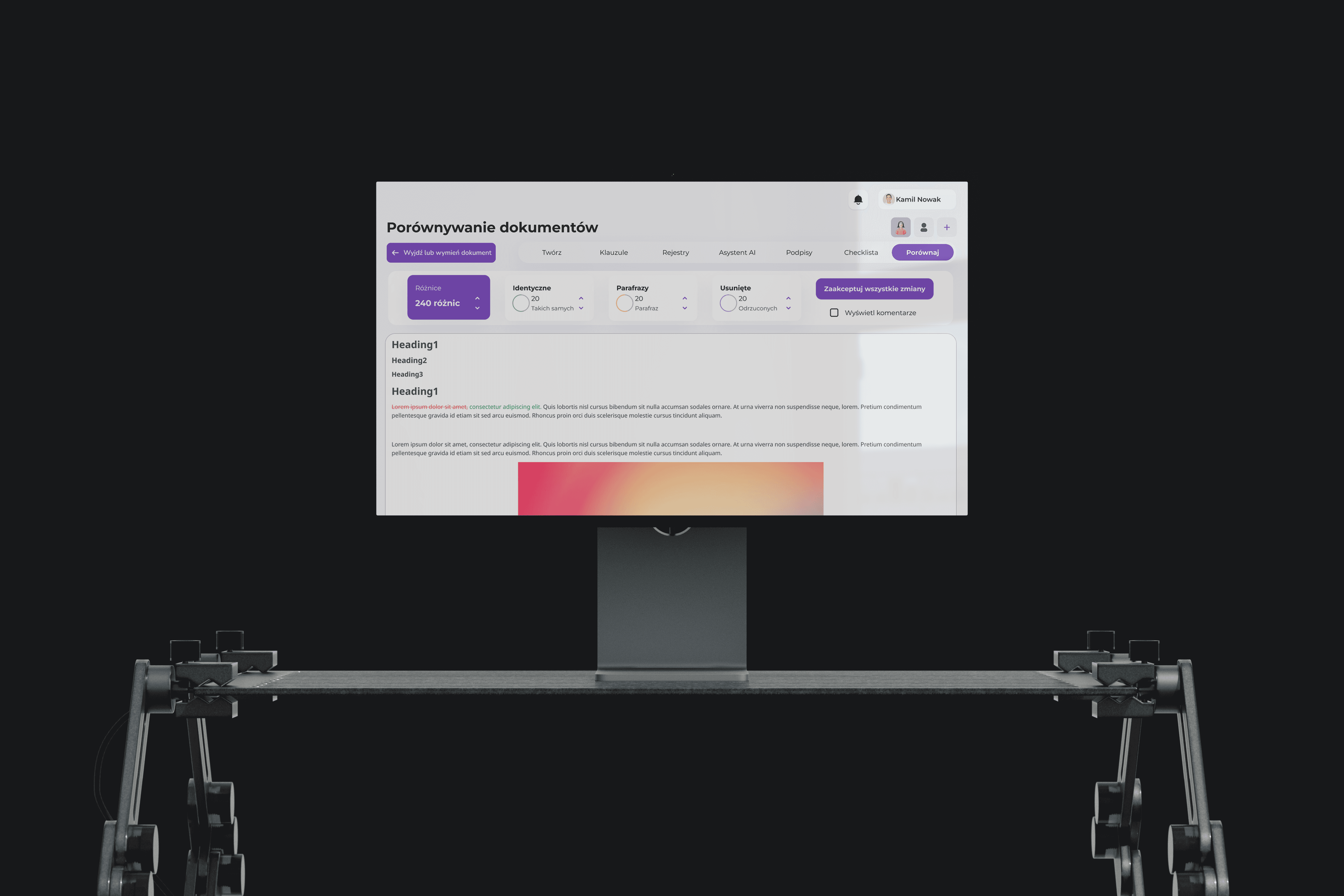
This was 2022. ChatGPT was not public yet. The model powering Legalspot was a small custom one trained on legal corpora, nothing like what you get from a modern foundation model. That shaped every design decision. Latency was slow, so I had to design loading states that explained what the AI was doing instead of hiding it. Accuracy was uneven, so the UI had to make it trivial to accept, edit, or reject suggestions without breaking the lawyer's flow. Confidence varied wildly between clauses, so I designed ways to surface that without scaring users off.
Working with PhD AI students meant every pattern was a negotiation between what the model could actually do and what lawyers needed it to feel like. A lot of the design work was inventing interaction patterns that did not exist yet, for a product category that did not exist yet.
The core task
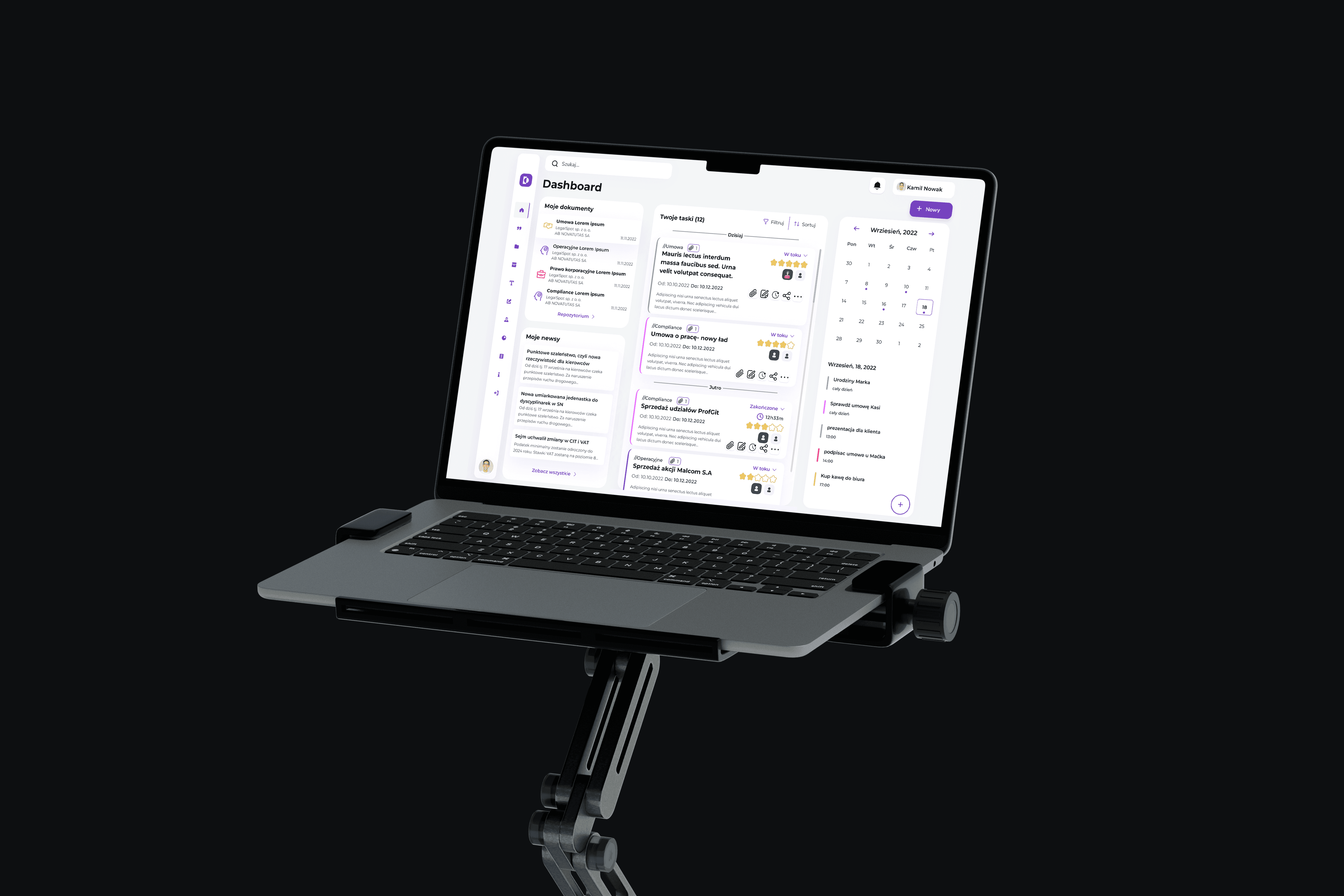
The job to be done was simple to describe and hard to design. A corporate lawyer sits down to draft a deal. They should be able to describe what they need, pull the right clauses from the firm's history, assemble a draft, share it with the client, track the response, and close the loop. I designed the full flow end to end, every screen, every state, every interaction.
Integration and permissions
Google Docs integration was non-negotiable because that is where lawyers already lived. I designed the sharing model, the version control surface, and the role-based access for partners, associates, paralegals, and clients. Audit trails were baked in from day one, because in legal work the question is always who changed what, when, and under whose authority.
Edge cases as first-class design problems
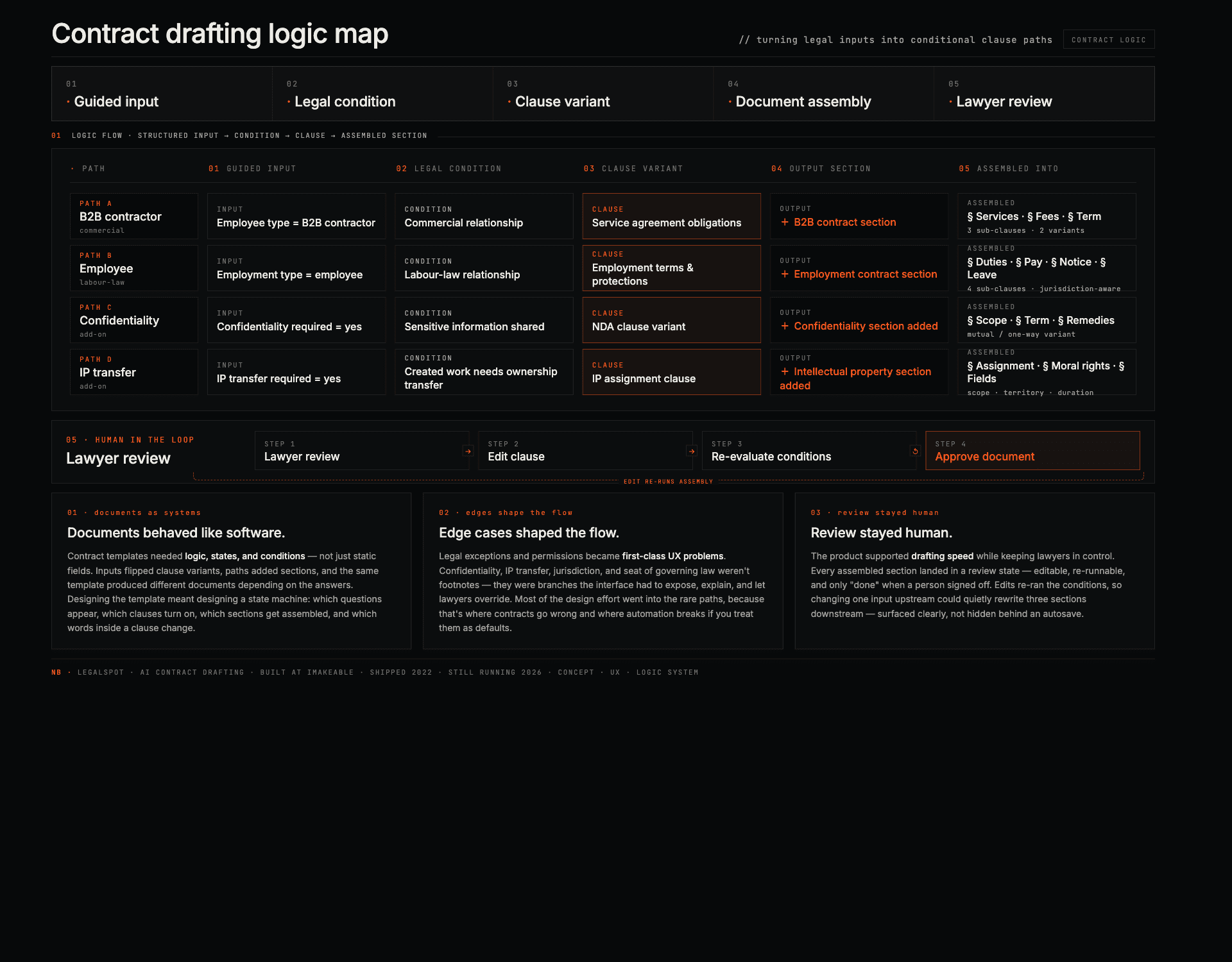
Incomplete data, conflicting versions, offline states, half-finished drafts that a lawyer came back to a week later. These are where legal software breaks trust, because losing a draft or missing a change is not a minor bug in this world, it is a client-facing problem. I spent real time on these states instead of treating them as afterthoughts.
Measuring it
We ran user research with corporate lawyers through build and after launch. The number that held up across sessions was around 25 minutes saved per document, which for a team drafting multiple deals a day adds up fast. That was the metric the founders took into their next conversations with investors.
What happened next
Legalspot launched, the team published the project, and I left the company shortly after. The product is still live in 2026, four years later, which is a rare thing for a pre-ChatGPT AI startup. The current marketing site is not my work, but the product underneath it is where I learned how to design for AI before there was a playbook for it.
Visit legalspot.pl
year
2022
timeframe
4-6 months
tools
Figma · Figma prototyping · Adobe Creative Suite (Illustrator, Photoshop, After Effects)
shipped in
Framer
category
UI/UX · AI Products
01
see also
0D0F11