Ailean. WhatsApp AI concierge.
A WhatsApp AI assistant for property managers and hotel owners. Led product and design on a three-month engagement: audited the AI behavior, redesigned the client dashboards, and shaped the integrations with third-party property management and hospitality platforms.
00
problem
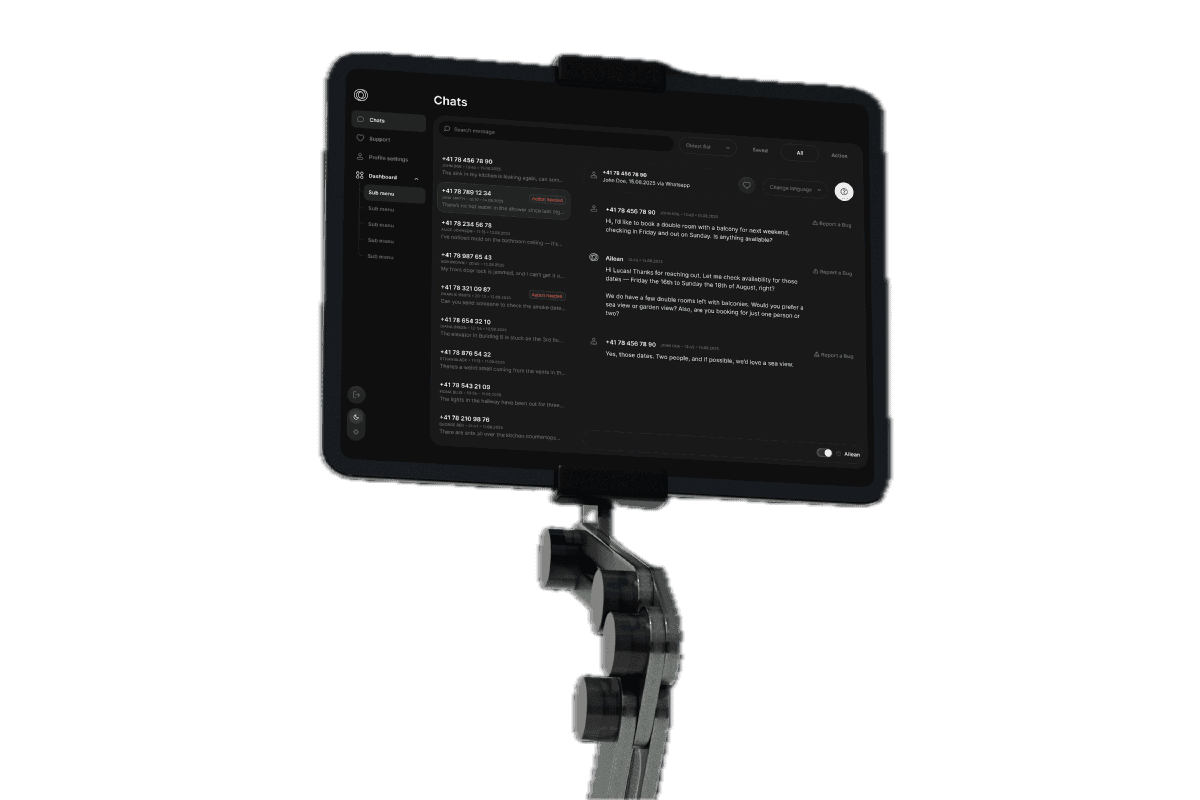
Ailean is an AI assistant that lives in WhatsApp. Two versions: one for property managers (it handles tenant problems so building managers can step back), and one for hospitality (so hotel guests can check in, report a broken shower, or ask where to eat without calling the front desk). Tenants and guests think they're talking to a human at the property. The managers see the AI working in a dashboard behind the scenes. The product was live when I joined. The core bet worked, but the execution was thin. The AI was a light wrapper on top of a generic model, with prompts and logic that couldn't hold up under real tenant complaints or guest requests. It made mistakes, reached for human help when it didn't need to, and came across as flat or off-tone. The dashboards the managers relied on looked like a chat inbox, which made it hard to see that Ailean was saving them time. And the data layer behind the AI was managed through Excel files that developers had to sync by hand twice a day. I joined as the sole product designer on a three-month engagement to stabilize the product, sharpen the AI, and give managers a reason to keep paying for it.
solution
Three work streams, in parallel. AI behavior audit and remediation. I audited the AI end-to-end and delivered a prioritized remediation plan covering prompts, persona logic, response length, emoji policy, language detection, error handling, and the places where the AI was replying before tenants had finished typing. I introduced customizable personas with language guardrails so a five-star hotel wouldn't sound like student housing and a property manager wouldn't sound like a concierge. Each vertical got its own voice without losing accuracy. Dashboard redesign. The existing dashboards were a list of chats. I redesigned them to lead with outcomes: time saved, problems resolved without escalation, common issues by property, and week-over-week trends. Fully responsive, light and dark mode, built to prove value to a B2B client who needs to justify the spend internally. Integration and onboarding redesign. The AI was only as smart as the property data behind it, and that data was stuck in client Excel files. I shaped the integration with third-party property management and hospitality platforms so updates could flow into Ailean in real time, and redesigned the client onboarding questions so we captured the data the AI actually needed instead of the data that was easy to ask for. By end of contract, the team estimated about a 20% improvement in response accuracy and roughly half as many human-intervention requests. Clients reported that the new knowledge flow had changed how they worked. The product was still live and running the same design when I left.
Joining a product that was live but not trusted
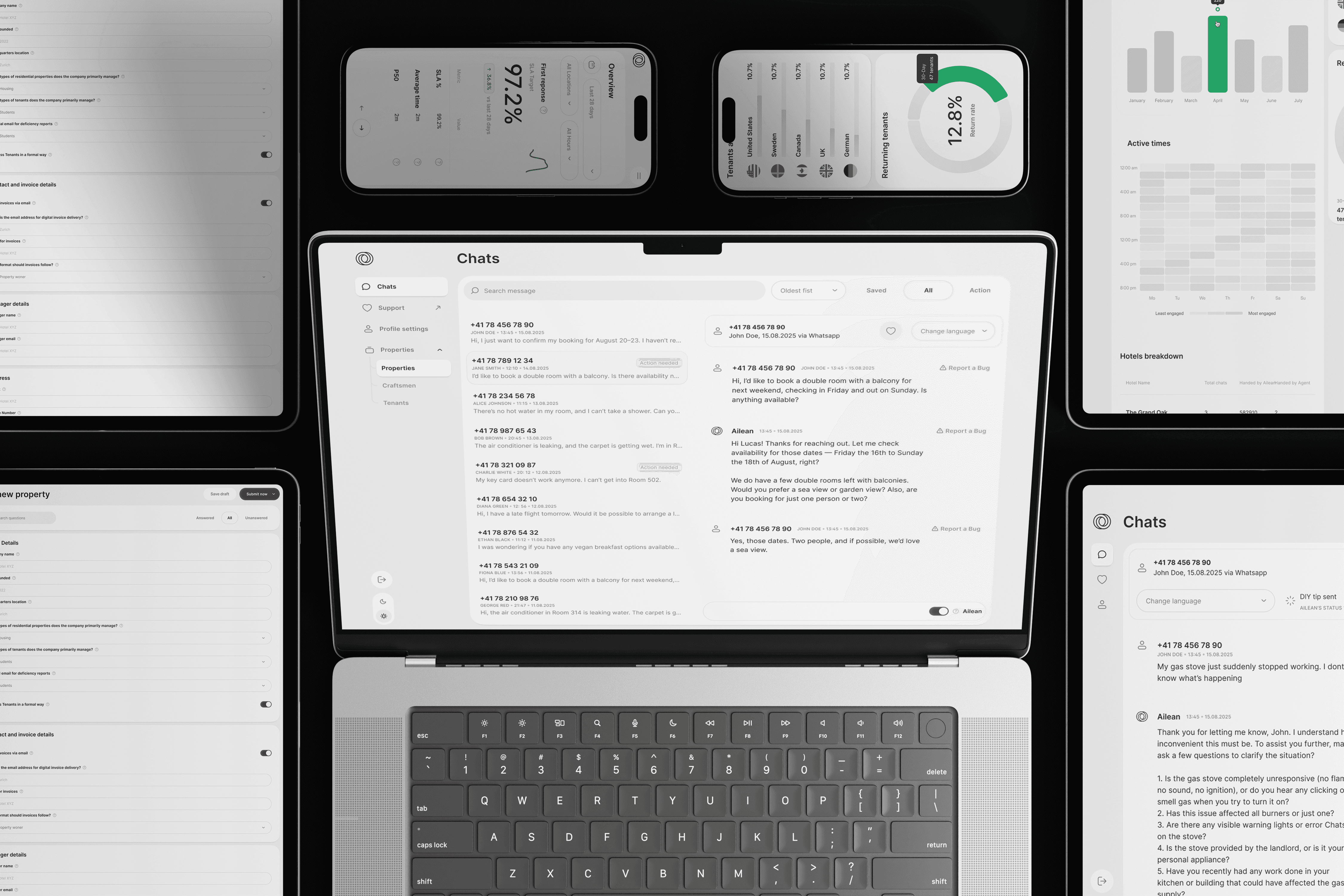
Ailean had paying clients when I joined. Property managers and hotel owners were already using it. The problem wasn't adoption. It was trust. The AI made enough mistakes that clients couldn't recommend it internally, and the dashboards didn't give them the evidence they needed to defend the tool to their own bosses. I joined as the sole product designer, reporting into the CEO and CTO, to stabilize the product across both verticals in three months.
Auditing the AI, not just the UI
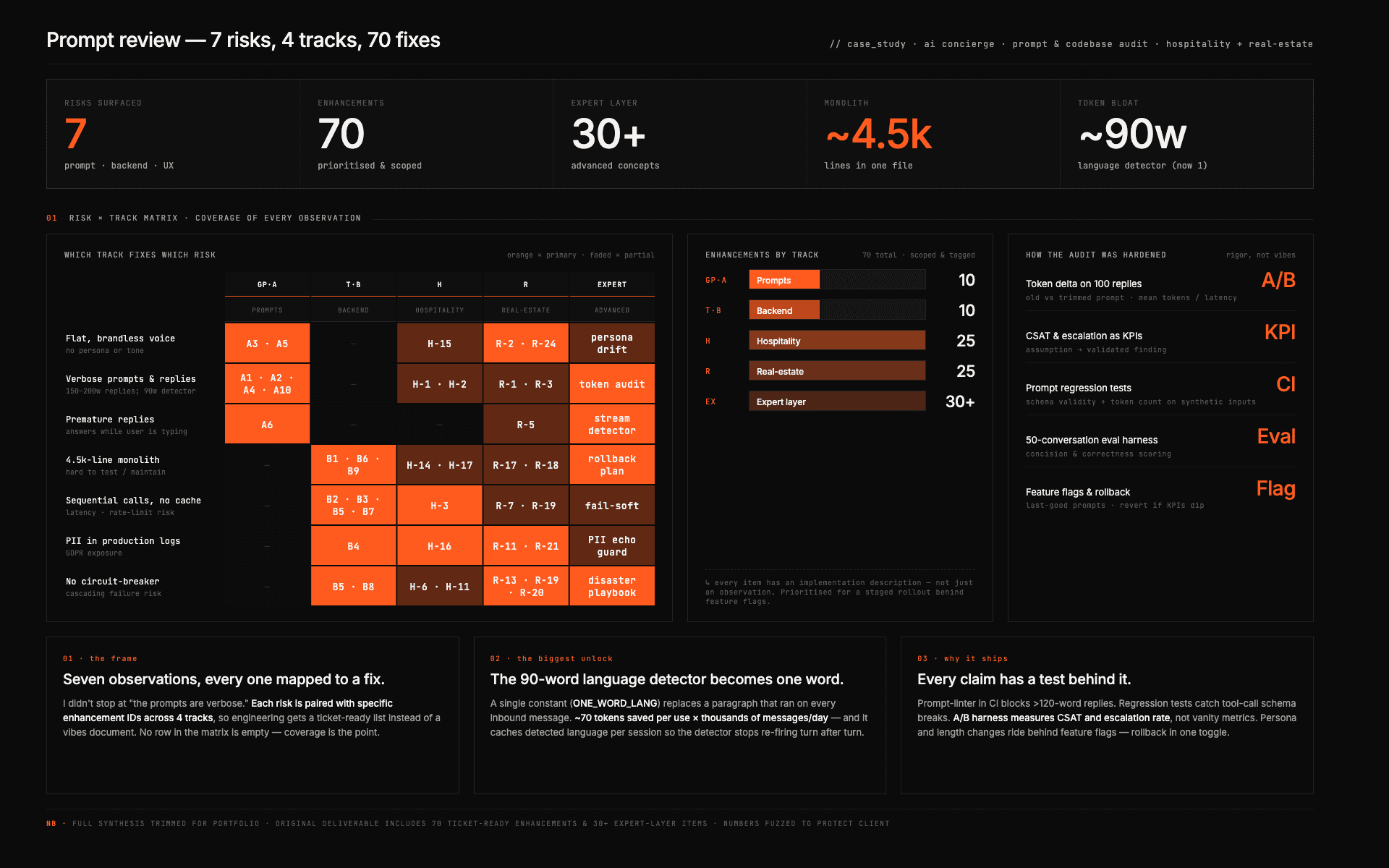
The first thing I did was put the product itself under the microscope. Not just the screens, the whole AI layer: the prompts, the persona logic, the response behavior, the places where language detection drifted, the moments where the AI answered a half-typed WhatsApp message and interrupted the tenant mid-thought. I wrote a full audit covering both AI behavior (prompts, persona, response length, tone) and backend resilience (caching, error handling, PII masking), and delivered it as a prioritized remediation plan the engineering team could work from.
Ten changes came out of the AI behavior side: persona injection per vertical, reply length caps, emoji policy, debounce on typing so the AI stopped replying to unfinished messages, persistent language detection, and a dictionary that translated backend error codes into messages a real tenant could understand. Each change was small. Together they changed how the product felt.
Designing personas for two very different rooms
A five-star hotel can't sound like student housing. A property manager can't sound like a hospitality concierge. But Ailean had one voice for everyone. I introduced customizable personas with language guardrails that let each client shape the tone without loosening the guardrails on accuracy. The persona system was injected at the start of every conversation and persisted across the session, so the tenant or guest experienced a consistent voice from their first message through escalation.
Redesigning the dashboards to prove value
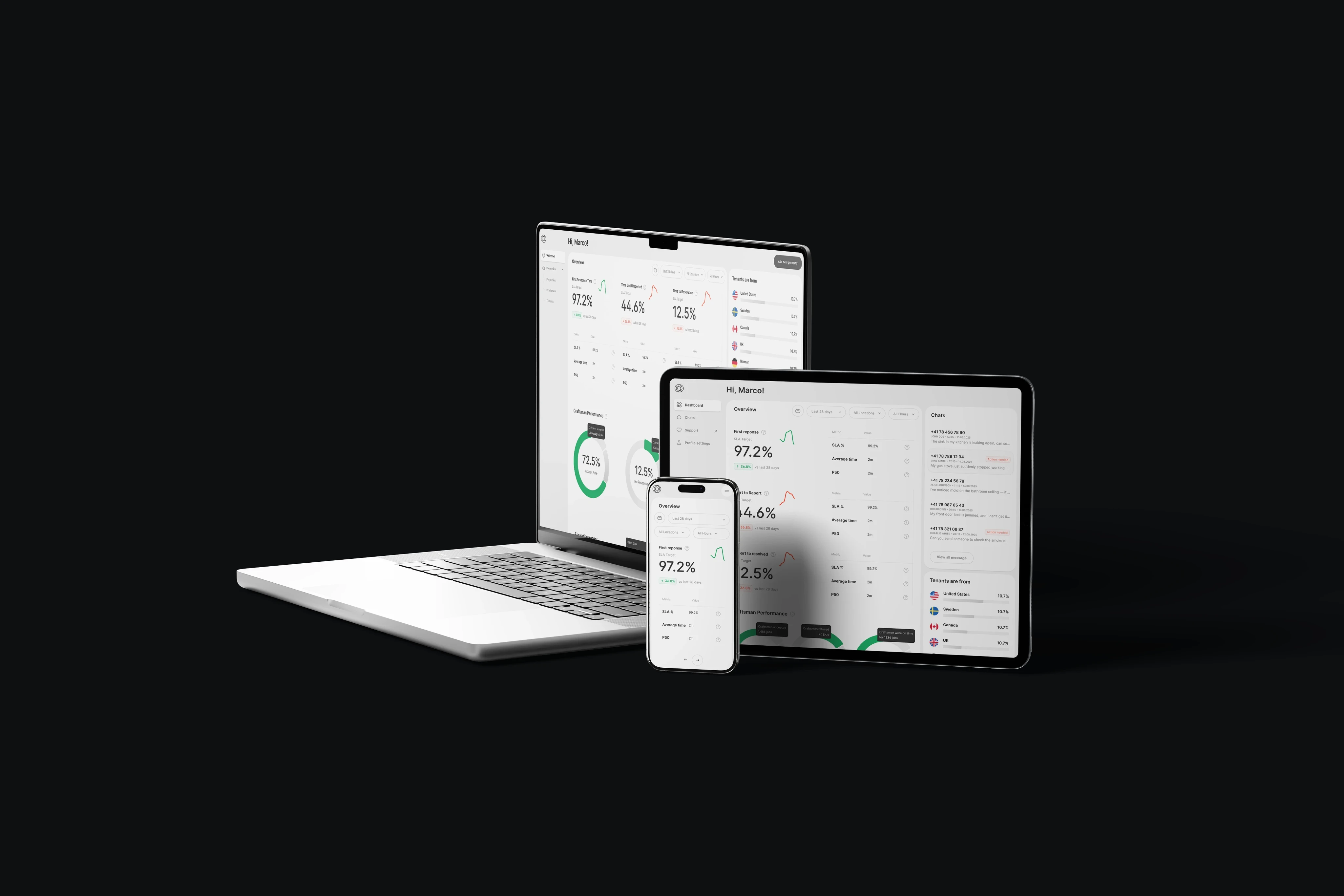
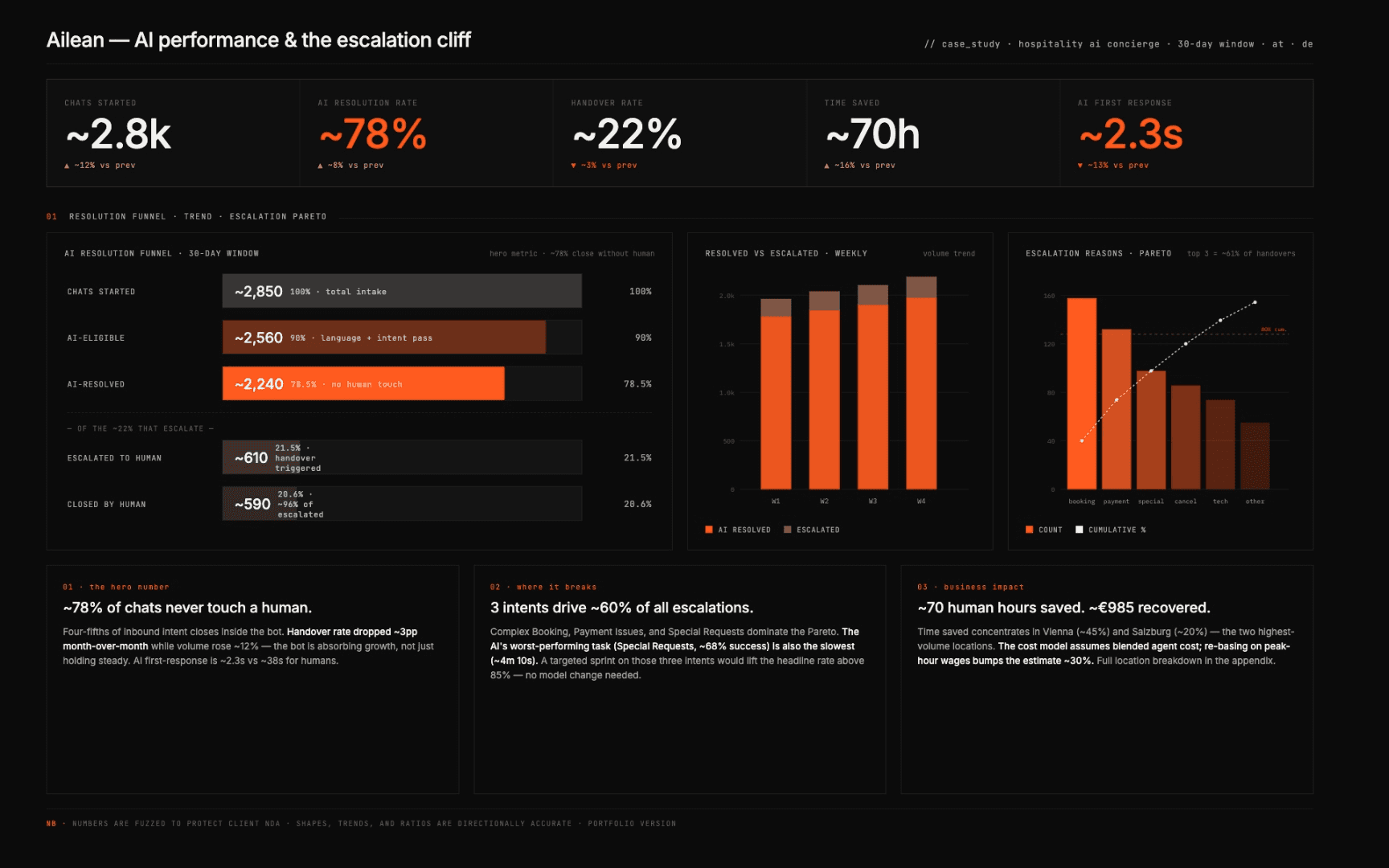
The existing dashboards were essentially a list of chats. If you were a property manager, that told you Ailean existed. It didn't tell you whether Ailean was worth paying for. I redesigned both product versions (property management and hospitality) to lead with outcomes: time saved, problems resolved without escalation, common issues by property, week-over-week trends. I also worked through the metric logic itself, so the numbers the dashboards reported were actually reliable, not cosmetic. B2B clients don't renew products they can't measure.
Fixing the data layer
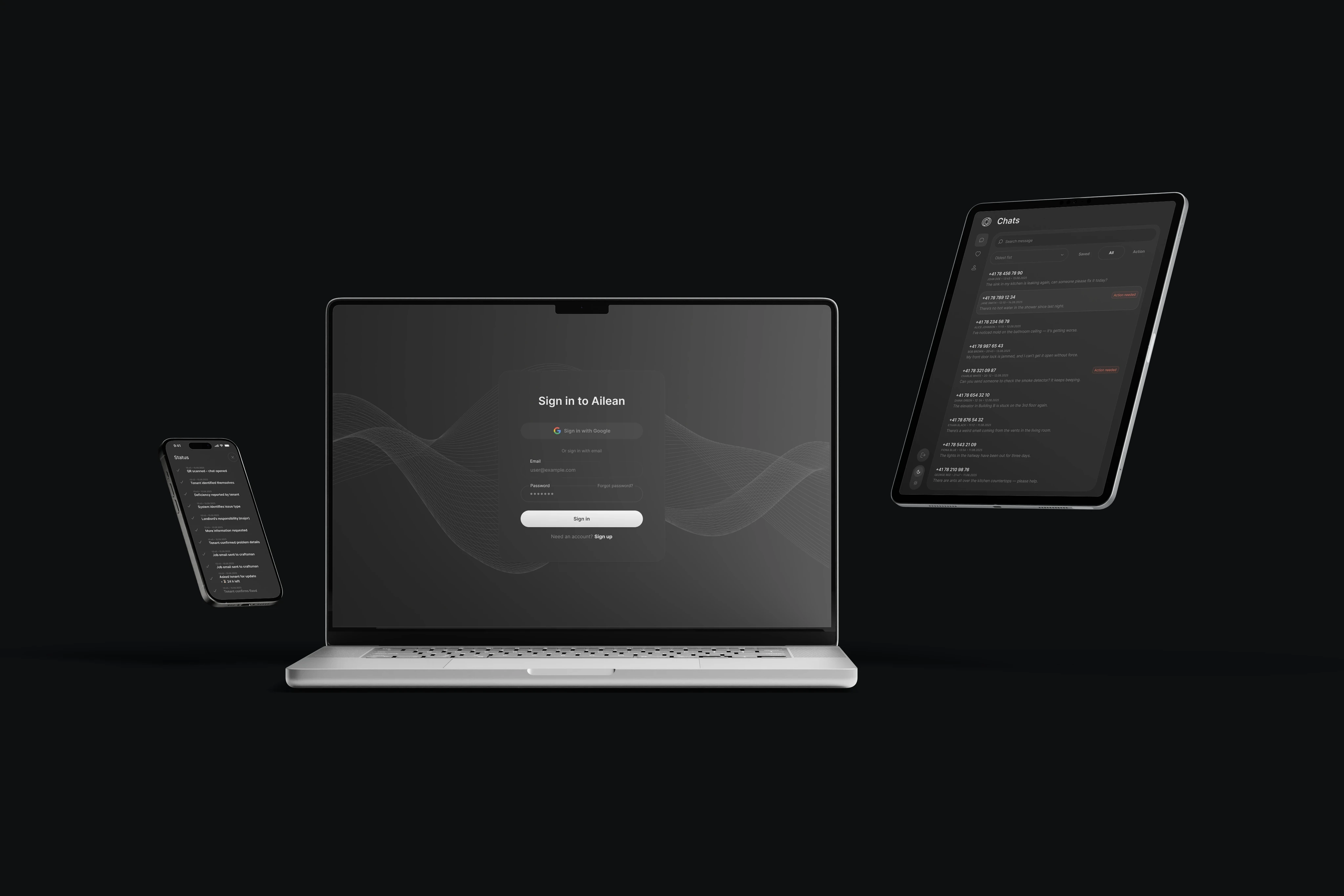
The AI was only as good as the property information behind it, and that data was stuck in client Excel spreadsheets that developers had to sync by hand twice a day. I shaped the integration with third-party property management and hospitality platforms so property data could flow into Ailean in real time. No more Excel syncs. No more twice-a-day lag. The client updates a property in their existing tool and the AI has it immediately.
I also redesigned the client onboarding questions. The old version asked clients what was easy to ask. The new version asked clients what the AI actually needed to function in their building: escalation contacts, response-time expectations per deficiency severity, budget thresholds for craftsman dispatch, and client-specific rules on how to handle angry tenants. The result was an AI that behaved correctly for each client from day one, instead of needing weeks of post-launch tuning.
Closing the loop with a YouTube knowledge base
Research into support requests showed that most tenant complaints didn't actually need a maintenance visit. People wanted guidance, not a plumber. I built a curated YouTube video database wired into the AI, so common issues (a tripped breaker, a dishwasher that won't start, a sticky window) could be triaged with a pre-approved tutorial before anyone got dispatched. It cut unnecessary service calls and let tenants solve small problems immediately instead of waiting for a manager to respond.
Prototyping with AI coding tools instead of waiting for engineering
Every iteration on the old process required engineering time, which meant every iteration waited in a queue. I built n8n simulations to validate user flows without engineering support, and I used Claude Code, Windsurf, and Cursor to prototype and ship features myself. Knowing enough code to put an idea in front of users (even as a rough working version) cut handoffs, reduced cost, and made the team faster. This was the first project where I leaned fully into vibe coding as part of my design process. It's now a permanent part of how I work on AI products.
Outcome and handover
Three months was tight. By the end, the team estimated a ~20% lift in response accuracy and roughly half as many human-intervention requests. Clients reported that the new knowledge flow and dashboards had changed how they worked, day to day. I delivered the AI audit, the redesigned dashboards for both verticals, the integration and onboarding redesigns, the YouTube knowledge base, and the documentation the team needed to keep going without me. The product is still live.
Visit ailean.io
year
2025
timeframe
3 months
tools
Figma · Claude Code · Windsurf · Cursor
shipped in
production · live with hospitality and real estate clients
category
UI/UX · AI Products
01
02
see also
0D0F11